To Visit My Website

To go to my website, click here.

Wednesday, October 19, 2011

Author Pam Carter Ripling aka Anne Carter

I'm so pleased to have author Pam Carter Ripling on my blog today. She's the author of several romantic-suspense novels (written as Anne Carter) as well as Young Adult books. She also writes non-fiction, freelances, and is the owner of Valdata Services, Inc, a trust accounting firm. You can read all about Pam and take a peek at her blog here.

I just finished reading "Cape Seduction", and it was good on so many levels. While on assignment in Northern California,  professional photographer Rebecca Burke thinks she sees a woman in red on the steps of a deserted lighthouse. She's determined to travel the treacherous waters to check things out for herself.  The anonymous owner is impossible to reach except through Los Angeles attorney, Matt Farralone, so Rebecca fibs her way out to the island to have a look around.  The discovery of an abandoned crib only peaks her interest, and she delves into the history with an eye toward clearing up unanswered questions.

As the mystery unfolds, the story flashes back to the 1940's, and we watch as the original drama unfolds alongside Rebecca's investigation. Starlet Darla Foster was last seen alive at the lighthouse where she starred in her first film. Coincedence? Or something more sinister? It was difficult to say which storyline captured my interest more, but the startling conclusion brings both ends together in a in a way that resolves both stories and satisfies the reader.

We’re casting your latest book for a movie. Who do you envision in the lead?
Since CAPE SEDUCTION takes place in two different eras and has two sets of characters, it has a variety of roles. Sometimes a particular actor will strike me as having a number of matching characteristics, and in this case the actor was Matthew McConaughey who filled out the role of present-day hero Matt Farralone (name was coincidental). Most interesting, to me, was my role model for Darla Foster, the heroine from the past. She was actually inspired by real-life 1920s actress Alice White, whose face appears on the cover. Playing her on film would probably  be Reese Witherspoon.  

Lighthouses. They feature in your romantic suspense books. Which comes first? The lighthouse or the story?
Good question! For POINT SURRENDER, the story came first, as the lighthouse is fictional. I did have a specific lighthouse in mind, but that sort of formed afterward. CAPE SEDUCTION, however, was written specifically about a very real lighthouse—inspired by and written about St. George Reef Lighthouse near Crescent City, California.

Pam, I want to know more about lighthouses--if they are publicly or privately owned, what they are being used for now, if there are still active ones off the California coast, if there are web sites and resources for people interested, and if they can visit and tour these lighthouses. What do you look for in a lighthouse for inspiration--the history, the architecture etc.?
Jackie, it’s estimated that there are about 680 lighthouses left in the U.S., of which around 600 are still operated by the U.S. Coast Guard. The rest are privately owned. Some of these are still operated and considered “active aids to navigation,” while others are private residences, bed & breakfasts, museums and landmarks. California has around thirty-six lighthouses at this time, protecting its 840 miles of coastline.
I visit as many as I can when I travel. There is nothing quite like the feel of climbing that winding staircase, hearing the echo in a cylindrical tower, peering out at the ocean once you’re at the top. You can almost hear voices from the past murmuring. Most inspiring for me is the architecture, the setting, and yes, sometimes the history. I’ve already chosen Angel’s Gate as the location for my third lighthouse mystery. This lighthouse, also known as Los Angeles Harbor Lighthouse, is another offshore beacon, and is completely unique in design.
Those interested in lighthouses can find a wealth of information online. One of my favorite sites is LighthouseFriends.com. These wonderful people have tons of useful information, including history, directions and accessibility to lighthouses all over the U.S.
Some of your books take place in or at least flash back to the past. How much research does this involve?
Glad you asked. Research is one of my favorite activities when writing a book. For CAPE SEDUCTION, I had a myriad of subjects to research. First, the late 1940’s era; the slang, clothing, pop culture. How much would Darla pay to see a movie? What would she wear? What was the airplane like she took to Northern California, and was there even an airport where she was going? More, if the characters smoke cigarettes, which would smoke the elite brand, and what was it called? For the lighthouse scenes, I had the good fortune to meet and interview a retired Coast Guardsman who’d actually lived at St. George. His recollections were invaluable.

Paper books haven’t disappeared, but ebook sales are growing. How does this affect you as a writer? For example, the writing process, how you work your appearances, etc.
I have always been a big proponent of ebooks, so I’m happy about the increase in sales. It affects me as a writer in the way I market. There used to be a bigger divide between ebook readers and those who prefer paper books. That gap is narrowing as people get more used to reading electronically. It’s not so much an “either, or” situation anymore. This is a good thing for writers who have had to divide their marketing energies and resources to cater to both types.
As for personal appearances, that’s an evolving animal. At a signing or a book fair, we are selling an intangible that people can’t hold in their hands. We are, essentially, asking them to take an active role, seek out the book online—if they can remember it—and buy/download it there. Over the years, some authors/publishers have tried selling ebooks on diskettes, CDs and DVDs, but to my knowledge it hasn’t been particularly successful.
Many authors have success with book clubs and even include questions on their web pages or in the books for these clubs to consider. What’s one question you’d like to ask readers to consider while reading your books?
Honestly, it’s something I’ve never thought about. On the fly, I think I’d want readers to be aware of the lighthouse-as-character aspect. What role does the lighthouse play? If the lighthouse has a personality, is it benign, helpful, safe, or is it antagonistic, dangerous, etc. The answer, of course, might lie with the POV of the character experiencing the lighthouse.
Social Media is such a big deal now. How much time do you spend on it, and what platform works for you?
I tried several at first, on the advice of my publisher. Like many, I use Facebook to stay in touch with fans as well as family, friends and fellow authors. I enjoy participating in Goodreads, both as an author and a reader. As for how much time I spend, it varies. Overall, I think people in general spend way too much time on social media. All one has to do is ignore it for a few days to discover how much of life passes by while sitting at the keyboard. There is a healthy medium that many exceed.
What’s the hardest part of being an author?
Getting books into the hands of readers. It’s a resounding issue. There is tremendous competition for the public’s attention and their dwindling disposable cash. We, as authors and publishers, spend a lot of time thinking up innovative ways to market books.
You write under two names. Why? And could you explain the differences in the books? And has it been confusing for readers at all?
My first romance novel was written 20 years ago. At the time, it was a very different and scary thing for me, but also exciting. Most romance authors I knew of had pseudonyms, so I thought I should, too. When I was finally published, my father had just passed away, and it meant something to me to use his (my maiden) name as a kind of homage. Hence, Carter.
After I’d written a few romances, I wrote a middle grade mystery. It seemed inappropriate to have both genres under the Carter name, since theoretically the younger readers could mistake one of my more “mature audience” books for another middle grade. It hasn’t caused any confusion that I know of.
Tell us what’s next for you?
As mentioned, I’m already at work on the next lighthouse book. I plan to offer more lecture dates in 2012, as I find more and more people are interested in lighthouses and literature. I enjoy the festival circuit and will likely turn up at the Ventura Author Festival and L.A. Times Festival of Books, where I participate with a group of mystery authors we call “Murder We Wrote.”
Thanks, Jackie, as always, for a stimulating and interesting interview!

Thursday, September 22, 2011

Battling the Writing Blues


Sometimes writing gives me the blues. That's pretty bad, considering I write comedy.

At my "real" jobs, I've always been a subordinate--subordinate to the clients and subordinate to my boss. I love it. So what's so great about answering to people, jumping through hoops, and trying to satisfy other people?

Two words. Defined Goals.

Okay. Four words. Defined Goals and Defined Deadlines.

Even when your client isn't sure exactly what he wants, the right questions can get you a definite something that he needs. And he always needs it right away. This goes for female clients, too. And Bosses, although bosses usually know exactly what they want from the start and they want it yesterday.

I miss that. You know what you have to do, do it, and get feedback. You know when you're finished. You put the file away and forget about it until the next frantic call.

With fiction, you write for an invisible audience and yourself. You only have self-imposed deadlines. You never know when you're finished, and most times it takes eons to get feedback, whether it's from a writer's group, an agent, or readers.

It's a lonely, twisted road, and that's where the blues come in.

So how to pull yourself  back into the light? I don't always know how.

Right now, the thought of re-defining my goals into tiny, completable steps makes me nauseous. I've done it too many times before and then dumped the goals when the dog got sick or a copywriting job came up (Yipee! Goals and deadlines, and money too!) Or when there was something good on TV.

Setting another deadline and shaking my finger at the page while saying No excuses this time, girlie! doesn't help either.

Things I've Tried

An invisible boss that I answer to. This worked alright for a while, but then I forgot about her. She's invisible.

A separate calendar for writing goals. I have too many calendars already. I'm easily confused.

Threats. You'll never have a house with a big California backyard for the dog to play in (read: average Midwest backyard) and he'll develop arthritis because he never gets to run around.

Real threats. Those bills are only going to get paid if you get some writing out there or get a job greeting people at Wal-mart. But if I'm at Wal-mart, who will be around to let the dog outside? What if he desperately needs to tinkle while I'm collecting carts from the parking lot. No, no, no!

And, finally, guiltThe guy in the parable punished the servant who buried his talents. Is that what you want? Buried talents? What kind of ingrate are you? You have an obligation to make people giggle.

What do you do to get out of the writing blues? And does it work?

Monday, August 29, 2011

Short Story Bonanza Aids Japan

I love short stories. They're like that tasty chocolate with the oozy caramel center--quick and delicious.

When a collection of short stories will aid people in need, that's an added bonus.

You'll find some of your favorite authors in "Shaken", an anthology to aid the victims of the Japan earthquake. Grab a copy! I did.

Monday, August 22, 2011

Best-Selling Authors Karen Ranney and Sue-Ellen Welfonder

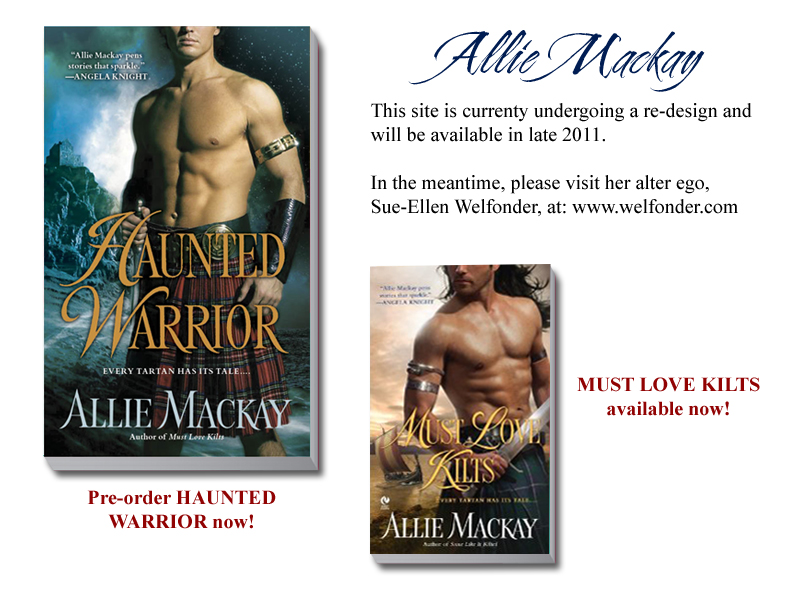
USA Today best-selling author Sue Ellen Welfonder writes Scottish medieval romances as well as Scottish-set paranormal novels, the latter appearing under the pen name, Allie Mackay , (website coming soon).

New York Times and USA Today best-selling author Karen Ranney writes Scottish historical romances set in the 19th century. She also writes contemporary romantic suspense novels which appear under her pen name, Katherine Storm.

They blog together at Tartan Ink .

 Welcome, ladies!

 “Two authors, one passion...Writing Scotland one book at a time.”  How did the two of you find each other? (And may I say that I LOVE that fans of your blog are referred to as “Tarts”.)

Karen:   We found each other through Digital Theft, believe it or not. I have often wished that more authors were active in hunting down those who steal our work. I don't believe, for example, that it's publicity. Sue-Ellen emailed me with a digital theft tip I hadn't realized, and I thought to myself: wow, another author like me. When she guest blogged at Warm Fuzzies, it was such a fun experience that we decided to do Tartan Ink.

Sue-EllenDitto to everything Karen said.  I’ll add that I was a hermit for years, keeping to myself and minding my own business.  Now and then, I’d glance at author blogs and eventually happened upon Warm Fuzzies.  I fell in love with Karen’s wit and outlook and knew I’d found a kindred spirit.  Like Karen, I hunt and report Digital Theft.  Through Warm Fuzzies, I knew Karen’s stance on Digital Theft mirrored my own.  One day I discovered a particularly evil trick used by Digital Thieves and emailed Karen, telling her about it.  We’ve been friends ever since.

How do you get across the language of the period, the Scottish dialect, and the medieval or 19th century references with the average reader in mind? (Definition of average reader for my purposes: One who is neither Scottish nor a student of history.)

Karen: I've always been fascinated with 19th century Scotland because it was a bridge over cultures. It was a hundred fifty years since the last battle with the English. On the outside, the Scots are good little British subjects, but their past was never far away. You could almost hear the thrumming beat of freedom calling. It's a duality that was buried, simmering below the surface, almost like today with the occasional cries for devolution.

Another thing that intrigues me is that the Scottish people are responsible for some of the greatest inventions that led to the lives we live today. Whether still living in Scotland, or expatriates, the theme of creation and risk-taking seems inherent in the Scottish spirit.

I don't write dialect. I may say something that reflects the cadence of speech, or use Gaelic, but I want the language to connect to the story, not put up a wall.

Sue-Ellen: Again, Karen and I resonate.  I, too, do not write dialect.  I believe there are other ways to convey a sense of Scotland without words like ye, yer, fer, and what-have-you.  Syntax, for one thing.  If I do use a Gaelic term or place name, I make certain the meaning is explained in the context.  I dislike heavy dialect of any kind and prefer to use words that are familiar to readers, while also giving a sense of time and place through how I use them.

If I were to write in language actually used by my medieval Scottish characters, no one would be able to read the books.

How much research is required when writing a historical novel?


Karen: It all depends on the plot. For example, The Devil Wears Tartan required a lot of history into Egyptology (which I love), Queen Victoria's Chinese expeditions, and the Opium Wars. Autumn in Scotland required that I read all about divorce, Scottish style, and inheritance law. Scottish law is not like English law.

The strange thing is - I do as much research on a contemporary, just to make sure I have the details right.

Sue-EllenTons, though only a small portion goes into the books.  I believe it is necessary for an author to know as much as possible about the time and setting of her work.  Only then, when you are wholly comfortable in that world, can you paint it vividly on the page.  Thankfully, most historical writers love research.  I certainly do and consider it one of the best perks of writing.

I’ve always been passionate about Scotland and medieval history, so I had a good working knowledge of medieval Scotland before I ever decided to write.  I’ve also been visiting Scotland all my life, so am familiar with the land and people.  Like Karen, I research deeper for specifics as needed.  As an example, I really studied the Black Death of the 14th C. for A Highlander’s Temptation.  My setting was far removed from the terrors of the plague, but it was going on in the world of that story.  I didn’t want to ignore it and so did a lot of really deep research and found a few fascinating tidbits I then wove into the book.

Romances, like mysteries, follow a certain formula. How do you keep your characters and plotlines fresh?

Karen: I think the characters are the ones who keep it fresh. If they're filled in, if you know enough about them, if they breathe, then the book is almost a living entity.

Sue-Ellen: Re plots... The path and destination may be the same, but it’s the individual journey that makes it fun.  It’s not so much the happy ending, but how they get there that keeps it fresh.

Re characters... Story people are as individual as real people.  Discovering their personalities and watching them come to life on the page is always a grand adventure.

Sue Ellen, you’ve branched out into paranormal novels. Was this a complete switch from Scottish romances, or an extension of that genre?

Sue-Ellen: Not a complete switch at all.  Definitely an extension.  Anyone familiar with my medievals will know that they’re bursting with paranormal elements.  And not just the usual Highland magic such a second sight and myth and legend.  There are also curses, ghosts galore, enchanted stones and animals, crones who work spells and other magic, mythical creatures, etc, etc…

I’m always surprised when someone blinks at my inclusion of such things because all the above and more were very much a part of medieval Scotland.  To leave out such elements would be to ignore a vibrant and colorful part of Scotland’s past.  I have great fun working such threads in my Scottish medievals and wanted to expand on that enjoyment with my Scottish-set paranormals.

For that reason, there are many touch-points between my Scottish medieval and my Scottish-set paranormals.  I love taking a modern day American heroine and sending her to Scotland where she either time travels to medieval Scotland or falls in love with a medieval Highland ghost hero.  These books are light and humor-filled and the heroines often live out my own travel adventures in Scotland which makes them great fun to write.

Karen, you also write contemporary romantic suspense novels. Are they easier to write than historical?

Karen: I think it's just as difficult to write either, frankly. My recent contemporaries feature San Antonio as a location, since it's my home. My historicals never mention an exact place in Scotland, because the setting is an amalgam of places. As far as plot, characters, pacing, all those are the same. The only difference in historical romance from contemporary suspense is the mores of 19th century Scotland - oh, and the clothing. I still insist on a Happy Ever After in my contemporary suspense, or at least the hint of one.

Both of you have pen names. Was this your choice or your publisher’s choice, and do you worry that readers of one name won’t discover all that you have to offer?

Karen: In my case, using the name Katherine Storm was my decision, to differentiate from my Scottish historical romances. These books are so different that I didn't want fans of one genre to be expecting something similar.

Sue-Ellen: It was my choice to use Allie Mackay for my Scottish-set paranormals.  Sue-Ellen Welfonder is my real name and, frankly, quite a mouthful.  When opportunity arose, I wanted a shorter, snappier name that also sounded Scottish.

I do worry about readers of one genre not reading the other.  But not because of the different names.  I’ve been very open about writing in two genres and using a pen name for one.  It’s no secret.  But I’ve discovered that very few of my historical readers read the Allie Mackay titles.  As noted above, there are so many shared elements in both types of books.  I’d hoped my historical readers would follow me into the second genre.  Some did, but most haven’t.  I have two sets of core readers with just a bit of mixed readers.

Sue Ellen, you’ve written a trilogy. Do you start a trilogy with the entire story in mind? And which do you consider easier to write--standalones, a trilogy, or a series? Does your approach to the characters differ with each format?

Sue-Ellen: Highland Warriors is my second trilogy.  I wrote my MacLean trilogy (Knight In My Bed, Master Of The Highlands, Wedding For A Knight) early in my career, although my publisher did not market the books as such.  My MacKenzie series also wasn’t marketed as a series, although it certainly was one.

I like to think all the books can be read as standalones, but writing-wise I prefer series.  I love revisiting well-loved characters and a setting that feels like home.  Yes, I have the over-all story in mind before starting a trilogy.  There has to be a powerful enough plot to sustain three books. 

My approach to characters doesn’t change with format or genre.  I’m always inspired first by an atmospheric setting and then the fitting character just ‘appears in my mind.’  I see them instantly and always full-bodied.  But they only come when I first know where the story is to take place.  My characters are always born of the setting.

Karen, you also blog on Warm Fuzzies. Is blogging an effective way for authors to get the word out about their books?

Karen: I think blogging is a great way to introduce yourself to people, but it's not for everyone. For example, I make a conscious effort not to talk about my books very often. When you go to Warm Fuzzies! - they're all there. If someone wants to buy one, they can. I also don't talk about writing all that often, even though I do like having guest authors.

Instead, I talk to my readers, and I think I've narrowed down who they are. Predominantly, women just like me. So, I'll talk about funny things, odd things, my peculiar view of the world, anything to reach out and connect with other people.

How much time do you both spend on social networking? Which venues get the best reader response?

Karen: I spend an hour a day. I love Goodreads, but I've also developed a liking for Facebook. I'd like to think that both blogs, Warm Fuzzies and Tartan Ink, generate the best response from people.

Sue-Ellen: I spend about the same amount of time on social networking as Karen.  About an hour a day, more around releases.  I’m fairly new to social networking, having resisted that whole scene for years.  I find self-promotion awkward and painful and have avoided such things for that reason.  I adore Twitter.  I can’t stand Facebook and will be taking down my page there.  I love blogging with Karen at Tartan Ink and enjoy popping by Warm Fuzzies.

I am not convinced that social networking sells books.  What I love is the immediacy of saying hello to friends on Twitter, catching word of neat blog articles and newsy bits tweeted there.  Above all, I LOVE Tartan Ink.  We have a warm and friendly community and I believe our readers enjoy visiting the ‘tea room’ each day.

When you read, do you stick to romance or is there another favorite genre that you indulge in?

Karen: I love almost anything. I'm a fiend for non-fiction. Right now I'm reading a collection of paranormal stories, a couple of motivational books, a contemporary romance, and a gritty crime novel.

Sue-Ellen: I adore cozy mysteries and Regency-set historicals.  I also love Karen’s books.  I have a set-in-stone rule not to read in my own genre, but I make an exception for her.  I also read tons of nonfiction.  As I love research, it’s pure pleasure to delve into books on all things medieval, Scottish history, Celtic myth and legend, archaeology, the paranormal (haunting, earth mysteries, and sacred places, etc.)

Karen again: Well, shoot, I have to add Sue-Ellen's books. Trust me, I do not read inside my own genre, so I was really annoyed that her latest book, Temptation of a Highland Scoundrel, was so good that it just grabbed me and wouldn't let me go. Truly, her books are wonderful, and she has such a magnificent way of depicting Scotland.  

What’s next for each of you?

Karen: I'm currently writing a very spooky and difficult book under the Katherine Storm name and soon to begin a new Karen Ranney book. I have A Scottish Love coming out November 29, 2011, and a few books in 2012.

Sue-Ellen: My next release is an Allie Mackay title, Haunted Warrior, out in Jan. 2012.  After that, comes Highland Warriors book three, Seduction of a Highland Warrior, also 2012.  Thereafter, a spin-off series from Highland Warriors.

Thank you both for stopping by A Writer's Jumble! You can find out more about each author's books at their websites, and I highly recommend their blogs.

Thursday, July 28, 2011

"Source Code": A Disturbing Type of Rape?

Spoiler Alert

Rape: "to seize, take, or carry off by force"

I just watched the movie Source Code. For those who haven't seen it, a nearly-dead soldier is attached to an 8 minute memory of a man who died in a terrorism attack so he can re-live those eight minutes over and over again to try to track down the terrorist. By the end of the film, he stops the attack, saves the victims and continues to live on through this guy's body.

Aside from the plot complications that come with time travel themes (they never can explain away all of the inconsistencies) there's another aspect of this film that I found disturbing. Make that horrifying.

Am I the only one who noticed that, while the hero goes off to enjoy life in another man's body, the man whose body he now inhabits has been shoved out of the picture? That guy has lost the rest of his life to his new "host". He's been taken over and now ceases to exist. The remainder of his life has been seized, taken by this soldier.

I had the same problem with "Lovely Bones". I didn't see the movie, but in the book, Susie Salmon jumps out of heaven, takes over another girl's body, and has sex with the boy she loved when she was alive.

Rape: "any act of sexual intercourse that is forced upon a person".

I can understand feeling gypped if you left this life without ever sharing intimacy with another person. But did anyone care that the girl whose body she took over gave up her virginity without consenting? What if the teenager had wanted to save herself for marriage? I know it's considered a quaint idea, but the point is she didn't have a choice. She wasn't even there for her first sexual experience.

Most movies and books aim for a feel-good ending, and we grown to care about the protagonists, Colter Stevens and Susie Salmon, but does this negate the rights of other characters? Should rights be governed by popularity contests?

It's a horrifying prospect.

Friday, July 22, 2011

Could My Creativity Save the Planet and My Checkbook?

Writers are creative people. There are all those articles about right brain versus left brain, and since I suspect that only half my brain is in use at any one time (and I'm not good at math), I'm hoping that the creative side is hard at work.

I recently decided that creativity might be the answer to a tightening budget and waster's remorse. Every time I toss a rotten head of cabbage, I think of starving families in China who, with just the right combination of spices, could have stretched that crucifer into ten meals.

And why, when I look in my pantry, can't I find anything good to eat? I do all of the grocery shopping. ALL of it. How did I manage to buy so many things I don't like or know what to do with?

A desire to tighten the budget combined with a sermon by Father Mike about waste have inspired me to a new challenge. I'm going to utilize everything in my pantry, freezer, and icebox with a bare minimum of shopping for ancillary items.

Craving a candy bar? I'll find a recipe online that uses that half a bag of walnuts, the scrapings from a jar of peanut butter, and baking chocolate. Milk, eggs, butter and dog food supplies are the exception, and if I run completely out of fruits or veggies, I'm allowed to resupply. Sound fair?

There will be less waste and less garbage going to the dump, so it's good for the planet, too.

I WILL have to overcome a fear of dwindling supplies, since I'm certain that the minute I use the last olive The Big One will come and I'll be forced to eat toothpaste. So be it.

I'm making a one week commitment to see how things go. I know one week isn't that long, but if creativity doesn't extend to my cooking, then one week will seem an eternity.

Monday, July 18, 2011

3 Ways to Healthy? Eat Like My Dog

I make Buster's food. After the commercial dog food scares, I'm committed. (Grinding up euthanised dogs? Really?) That doesn't mean he doesn't get the occassionally crunchy goodness of kibble, but it's really good kibble from manufacturers I trust. And he gets bones. Lots of bones.

My husband has wandered into the kitchen while I've been making Buster's chow and asked me, "What's for dinner?" Yes, it's that good. Ground meat, veggies, grains...It could be a casserole.

I also treat him with fruit or dried chicken strips, and I've made him cookies from ground meat, oatmeal, rice flour, fruit and cheese.

It occurred to me that I worry more about Buster's food intake than I do my own. I never give him cupcakes or candy bars, and I drain the heck out of the ground beef when I use it. While my own butt expands, I'm watching his wasteline. Did you know doggies can get diabeties?

Here's a few adjustments I need to make to my own diet to match Busters.

1. Make it from scratch.

There will be days when I'm pressed for time and grab some processed box of something-or-other for dinner. But I promise myself (and the hubby, who would stand in the kitchen, helpless, if he had to cook his own meals) that I will endeavor to cook from scratch. That means make my own bread for sandwiches, buy cuts of meat to cook and shave for the sandwiches, make any treats from scratch etc.)

This isn't as hard as it sounds because I'm the luckies woman in the world. I have a bread machine. I have a meat slicer. I have the time.

2. Eat more fruit

Buster's after-walk treat is an apple with the core removed. He also loves watermelon, mango, and blueberries. I do love my snacks. While I'll never give up chocolate, I promise to first reach for the fruit bowl.

3. More grains and veggies than meat.

It may surprise you to know that you don't need to feed your dog that much protien unless he's a working dog or she's a lactating or pregnant female. Buster is neither. He also has colitis, which is a nasty thing that is easily cleared up with increased fiber in his diet.

I cut back on the meat in his dog food recipe and increased the veggies. Cured. I promise to balance my meals more towards grains and veggies than yummy, delicious, meat. (Can you tell I'm a devoted carnivore?)

There are more ways I could adjust my diet--eliminate any sugary snacks, give up my glass of wine at night--but I'll try the first few and let you know how it works. We do need our treats! After all, Buster does have his bones.

A Swell Online Conference You Might Enjoy

This is a courtesy post for a fabulous writer's conference that I've attended in the past. Check out the class schedule. A lot of th...